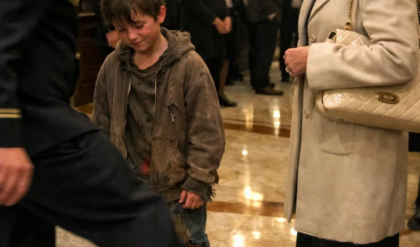
The Bru:ised Boy Walked Into a Biker Clubhouse Asking for a Job No One Expected Him to Survive — “Wrong Place, Kid,” Someone Laughed, But the Moment the Leader Took One Look at His Face and Quietly Made a Call, Everything About That ‘Simple Request’ Turned Into Something That Would Change the Boy’s Life Forever
The first thing people remembered wasn’t the boy’s face—it was the way he stood in the doorway like he had already decided he wasn’t leaving, no matter how many reasons the world might hand him to turn around, and in a place like the Rust Fangs clubhouse, where grown men twice his size had walked in with less certainty, that quiet resolve landed harder than any noise ever could.
The door gave that long, complaining groan on its hinges, the kind that made conversations pause even before anyone saw who had entered, and then the room shifted in that subtle, almost instinctive way spaces do when something unexpected crosses the threshold. Pool cues hovered mid-air, a half-laughed joke died somewhere near the bar, and the jukebox clicked into silence like it understood this wasn’t a moment for background noise.
The kid didn’t look like trouble in the way people usually defined it, which somehow made him more unsettling to the men inside. He looked like the aftermath of trouble—the kind that leaves marks no one bothers to explain. His hoodie swallowed his frame, sleeves hanging past his wrists, the fabric worn thin at the edges, and his sneakers were patched with strips of duct tape that had been pressed down and replaced so many times they formed a kind of rough armor around the soles. His face was angled downward, but not enough to hide the bruise that spread across his cheekbone in uneven shades of purple and yellow, a story half-told and already dismissed before anyone asked.
“Wrong place, kid,” someone muttered from the back, not unkindly, just automatically, like a reflex built from years of guarding a space that didn’t welcome outsiders.
A couple of men chuckled, the sound thin and dismissive, already turning back to their drinks as if the interruption had been nothing more than a draft through a cracked window.
But the boy didn’t move.
He stepped inside instead, slow and deliberate, and let the door fall shut behind him with a weight that felt heavier than it should have, sealing him into a room where most adults hesitated to linger.
“I’m looking for work,” he said, his voice quiet but steady, the kind of steadiness that comes from holding yourself together for longer than anyone should have to at twelve years old. “After school. I can clean, sweep, organize, whatever you need.”
This time the laughter came louder, sharper, echoing off the concrete floor and the walls stained with years of oil and smoke.
Rex—broad-shouldered, beard thick as wire, a man who had built his reputation on never taking anything seriously unless it demanded it—let out a bark of amusement and slapped his palm against the table. “You hear that? Kid thinks this is a help-wanted sign.”
But not everyone was laughing.
At the far end of the room, near the window where the light came in at an angle that softened nothing, a man shifted in his chair and stood.
Gideon Hale didn’t move quickly. He didn’t need to. His presence carried weight long before his steps did, the kind earned over years of decisions that left marks you didn’t show off but never quite lost. His head was shaved close, a pale scar cutting from his temple down toward his jaw, and his eyes had that unsettling clarity of someone who had learned to read people because missing details had once cost too much.
The room quieted as he approached.

“What’s your name?” Gideon asked, his voice low, roughened by time but controlled in a way that made people listen even when they didn’t want to.
The boy hesitated, just for a fraction of a second, as if weighing something invisible.
“Eli Turner.”
“Eli what?” Gideon pressed gently.
“Turner,” the boy repeated, a little firmer this time.
Gideon studied him for a long moment, taking in the posture, the way his hands stayed buried in his pockets, the tension held just beneath the surface like a wire pulled too tight.
“You live around here?”
Eli nodded. “Maple Ridge. The white house with the broken fence.”
Something flickered behind Gideon’s eyes.
He knew that house.
Everyone who paid attention did.
A foster placement. Temporary on paper, permanent in the way some situations quietly became. A couple named Harold and June Carver ran it—on record, respectable, compliant, the kind of people who filled out forms correctly and spoke in polite tones. Off record, stories circulated, never loud enough to trigger action, always enough to leave a residue of doubt.
Gideon’s gaze shifted back to the bruise.
“That’s a rough fall,” he said, not quite a question.
Eli’s jaw tightened. “Yeah.”
“From what?”
“My bike.”
“You ride often?”
“Sometimes.”
“Where’d you fall?”
Eli’s eyes flickered, quick and sharp, the kind of glance that told a story even when the mouth refused to.
“Does it matter?” he asked, and there was something brittle in the question, something that suggested he already knew the answer most people would give.
Gideon held his gaze.
“Yeah,” he said quietly. “It does.”
The silence stretched.
Around them, the room pretended not to listen, but no one had gone back to their game or their drink. Even Rex had gone still, his earlier amusement fading into something more cautious.
Gideon exhaled slowly, then nodded toward a worn couch near the window.
“Sit,” he said. “Give me a minute.”
Eli didn’t argue.
He walked over and lowered himself onto the edge of the couch, hands still buried in his pockets, shoulders slightly hunched as if bracing for something that hadn’t happened yet.
Gideon didn’t head for the garage.
He stepped outside.
Two hours passed.
The clubhouse returned to motion in small, careful increments, conversations picking up in quieter tones, the rhythm altered but not broken. A woman named Carla, who handled most of the cooking and half the logistics no one else wanted to think about, set a sandwich and a soda beside Eli without saying a word. He stared at it for a long time, as if unsure whether it was meant for him, before finally taking a bite with the cautious focus of someone who had learned not to assume abundance.
When Gideon came back, Eli was exactly where he’d left him.
That mattered more than he let on.
“All right,” Gideon said, crouching in front of him, bringing himself down to eye level without making it a show of authority. “Here’s what we’ve got. Cleaning, organizing, basic shop work. Ten bucks an hour. Three days a week. You show up on time, you do the work right, and you don’t lie. About anything. You understand?”
Eli blinked, just once, and in that brief movement something shifted—something small, fragile, but real.
“Yes, sir.”
“Don’t call me sir,” Gideon replied. “Makes me feel older than I am.”
A faint, almost invisible hint of a smile flickered across Eli’s face.
“Okay.”
“Tuesday,” Gideon said. “Four o’clock.”
Eli nodded, stood, and headed for the door.
“Eli.”
He turned.
“That bruise didn’t come from a bike,” Gideon said, not accusing, not pressing, just placing the truth where it could be acknowledged.
Eli’s expression went still again, the mask slipping back into place.
“I’ll be here Tuesday,” he said, and left.
The door closed, and the room exhaled.
Rex shook his head. “You serious about this?”
Gideon looked out the window, watching the boy’s small figure disappear down the street.
“That kid didn’t come here for money,” he said quietly. “He came here because he ran out of places to stand.”
Tuesday came, and Eli was early.
He stood outside for nearly a minute before knocking, as if giving himself one last chance to walk away from whatever he was stepping into.
Gideon opened the door before the second knock.
“Good,” he said. “You’re on time.”
The garage out back was a different world—organized chaos, tools hung in precise rows, engines disassembled and waiting, the air thick with the smell of oil and metal and something almost like purpose.
“This is Leon,” Gideon said, nodding toward a wiry man with hands permanently stained from years of work. “He’ll show you what needs doing.”
Leon glanced up, studied Eli with sharp, assessing eyes, then jerked his chin toward a corner.
“Broom’s there. Start with the floor. Don’t miss the edges.”
Eli nodded and got to work.
He didn’t rush.
He didn’t cut corners.
He swept like the act itself mattered, like every stroke was a step toward something he hadn’t quite named yet.
Leon pretended not to watch.
But he noticed.
After an hour, he tossed a box of mixed bolts and washers onto the floor.
“Sort these,” he said. “By size, by type. Keep it clean.”
Eli sat cross-legged and began.
Not just sorting.
Organizing.
Creating order where there had been none.
Rows formed, precise and deliberate, each piece placed with care that spoke of a mind trying to make sense of a world that hadn’t given him much structure.
Leon crouched beside him after a while, eyes narrowing slightly in something like respect.
“You’ve done this before,” he said.
Eli shook his head. “No.”
“Then you learn fast.”
Eli didn’t respond.
But his hands kept moving, steady and sure.
Weeks passed.
Eli showed up every time.
Early.
Consistent.
Quiet.
The bruise on his face faded, replaced by others in different places, less obvious, easier to miss unless you were looking for them.
Gideon was.
So one evening, as the others filtered out and the garage settled into a quieter rhythm, he leaned against the workbench and watched Eli finish stacking a set of cleaned tools.
“You want to tell me what’s going on at that house?” he asked.
Eli froze, just for a second.
Then he shook his head.
“It’s nothing.”
Gideon didn’t push.
“Nothing doesn’t leave marks like that,” he said evenly.
Eli swallowed.
“They say it’s discipline,” he said finally, the words coming out slow, as if each one had to be forced past something lodged in his throat. “They say I’m difficult.”
Gideon’s jaw tightened.
“You’re not difficult,” he said. “You’re a kid.”
That was the moment something cracked.
Not loudly.
Not dramatically.
But enough.
Over the next week, Gideon made calls.
Quiet ones.
To people who knew how to listen.
To people who understood how to look closer when something didn’t sit right.
What followed didn’t explode into chaos.
It unfolded.
Carefully.
Methodically.
Investigations that didn’t rely on rumor but on evidence. Conversations that peeled back layers of polite appearances and revealed patterns no one had wanted to see clearly before.
The Carver house didn’t look the same under scrutiny.
Records didn’t match.
Stories didn’t align.
And when the truth finally surfaced, it didn’t need to be shouted.
It spoke for itself.
Eli didn’t go back there.
Not after that.
Instead, he stayed.
At first temporarily.
Then longer.
Arrangements were made—legal, proper, undeniable this time.
The town noticed.
Not just the outcome.
But the way it happened.
The way a place most people avoided had become, for one kid, the first place he had ever been asked to show up instead of stay quiet.
Months later, on a clear afternoon, Eli stood in the garage, sleeves rolled up, hands steady as he worked on a small engine under Leon’s watchful eye.
“You’re getting good,” Leon said.
Eli glanced up, a real smile this time, unguarded and solid.
“Yeah,” he replied.
Across the room, Gideon leaned against the doorway, arms crossed, watching.
Rex stepped up beside him, shaking his head with a half-grin.
“Kid walked in asking for a job,” he said. “Didn’t even know what he was really asking for.”
Gideon’s gaze stayed on Eli.
“Yeah,” he said quietly. “He did.”
Outside, the town carried on, a little different than it had been before, though most people wouldn’t be able to point to exactly why.
Inside the garage, a boy who had once stood in a doorway with nothing but quiet determination now stood with something more.
A place.
A purpose.
And the kind of future that doesn’t announce itself loudly—but stays.