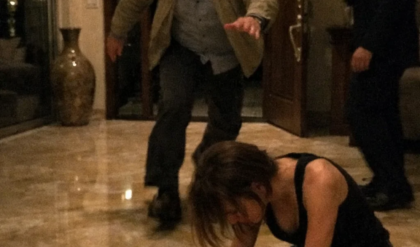
The Billionaire Mocked His Niece for Drawing “Meaningless Circles” on the Floor During a High-Stakes Meeting — “This Isn’t a Playground, Stop Making a Mess,” He Said as He Erased Them with His Shoe, But Moments Later When Every Screen Turned Red and His Empire Began Collapsing in Real Time, the Only One Who Understood What Was Happening Was the Girl He Had Just Pushed Aside
The first thing people always noticed about the room was how carefully everything in it had been arranged to suggest control, as if the polished wood, the perfectly aligned monitors, and the quiet hum of expensive machines could convince anyone standing inside that nothing unpredictable had ever happened there and nothing ever would.
That illusion lasted exactly until the moment the red alerts began to flicker across the screens.
But that came later.
At the beginning, it was just a girl on her knees, drawing circles on the floor.
Her name was Elara Quinn, and she had learned a long time ago that when adults underestimated you, they often stopped noticing what your hands were actually doing, which in her case meant that while a room full of well-dressed men discussed markets, mergers, and movements of money that sounded abstract until they ruined someone’s life, she sat quietly on a thick rug beside a mahogany desk, chalk dust gathering on her fingertips as she traced loops that looked meaningless unless you knew how to read them.
“Look at her,” her uncle said, his voice carrying easily over the low hum of conversation, the kind of tone that turned a child into a prop without ever sounding openly cruel. “Our little genius at work again.”
A few of his colleagues chuckled, glancing down at her with polite amusement, their attention already drifting back to more important matters, because to them she was nothing more than a distraction, something harmless, something that filled space while real decisions were being made.
Elara didn’t look up.
She kept drawing.
The circles weren’t random.
They never were.
Each one connected to another, overlapping, intersecting, forming patterns that only made sense when viewed as a whole, and she was careful—always careful—to place them in a way that reflected what she had been listening to for the past hour.
“Leverage the offshore channel through the second layer,” one man had said earlier, his voice low but not low enough.
“Roll the exposure forward,” another had added, tapping a finger against the edge of the desk.
“Keep it moving,” her uncle had concluded, smiling that particular smile he reserved for moments when he believed himself to be cleverer than everyone else in the room.
Elara translated those words into shapes.
Loops.
Paths.
Pressure points.
By the time she reached the edge of the rug, the pattern had become something complete, something that mapped not just movement, but fragility—the exact places where everything holding his carefully constructed world together could begin to unravel.
“Still at it?” her uncle said, stepping closer now, his shoes clicking softly against the hardwood floor as he approached, his shadow falling across her work.
She paused for a moment, then added one final circle, smaller than the others, positioned just slightly off-center.
“That’s the trigger,” she said quietly, more to herself than to him.
“What was that?” he asked, though his tone suggested he wasn’t particularly interested in the answer.
Elara looked up then, her expression calm in a way that often made adults uncomfortable without them understanding why.
“It’s where everything connects,” she replied.
Her uncle let out a short laugh, glancing back at his guests. “You hear that? She thinks she’s building something important.”
The laughter that followed was louder this time, less polite, more dismissive.
“Kids and their imaginations,” one of the men said, shaking his head.
Elara didn’t react.
She had learned not to.
“Stop drawing on my floor like a child,” her uncle said then, the edge in his voice sharpening just slightly as he looked down at the chalk lines spreading across the rug and onto the hardwood beyond. “This isn’t a playground.”
He stepped forward, and before she could move, he dragged the sole of his shoe across the nearest circle, smearing it into a cloud of pale dust that broke the pattern apart in a way that felt almost deliberate.
“See?” he added, grinding his heel into another loop. “That’s all it takes to erase nonsense.”

Elara’s hand tightened slightly around the piece of chalk.
“That wasn’t nonsense,” she said.
He didn’t like that.
Not the words.
The tone.
There was no fear in it.
No apology.
Just quiet certainty.
He reached down and shoved her back, not violently, but firmly enough that she lost her balance and hit the edge of the bookcase behind her, the chalk slipping from her fingers and clattering softly against the floor.
“Enough,” he said, his smile returning, though it didn’t quite reach his eyes this time. “You’re making a mess in a place where things actually matter.”
The room went quiet, but not with concern—more with the kind of attention people gave when something uncomfortable happened and they weren’t sure whether to acknowledge it or pretend it was part of the entertainment.
Elara pushed herself up slowly, brushing chalk dust from her palms, her gaze dropping briefly to the floor where the pattern had been partially destroyed, then lifting again to meet her uncle’s.
“You just erased the map,” she said.
He raised an eyebrow, amused despite himself. “The map of what?”
She held his gaze, unflinching.
“Your collapse.”
For a second, no one spoke.
Then he laughed, louder this time, turning back to his guests as if to invite them to share in the absurdity.
“You hear that?” he said. “My own niece predicting the end of my empire.”
A few of the men smiled, though there was a faint hesitation now, something in the air that had shifted almost imperceptibly.
And then—
One of the monitors on the desk flickered.
At first, it was subtle.
A brief flash.
A line of red text that appeared and disappeared too quickly to read.
Then another.
Then three at once.
“What—” one of the men began, his attention snapping toward the screens.
The room changed in an instant.
The low hum of conversation vanished, replaced by the sharper, more urgent sounds of alerts triggering in rapid succession, each one carrying a tone that was just different enough to signal a separate problem, a separate failure, a separate piece of something larger beginning to break.
Her uncle turned, his expression shifting from irritation to confusion, then to something closer to disbelief as he stepped toward the desk.
“That’s not possible,” he said, reaching for the keyboard, his fingers moving quickly, pulling up data, refreshing feeds, trying to force the system to show him something different from what was already there.
But the screens didn’t change.
If anything, they grew worse.
Numbers dropped.
Indicators flashed.
Connections he had relied on for years began to unravel in real time, each one triggering the next in a chain reaction that moved faster than he could respond.
“Margin alert,” one of the systems announced in a flat, mechanical voice.
Another followed.
Then another.
“What did you do?” one of his colleagues demanded, stepping closer, his earlier amusement gone entirely.
“Nothing,” her uncle snapped, though the word sounded less certain than he intended. “This is a glitch. It has to be.”
“It’s not a glitch,” Elara said quietly.
No one had noticed when she moved.
But she was standing now, a few steps behind him, her gaze fixed on the screens with the same calm focus she had shown while drawing.
He turned slowly, his expression tightening.
“What did you say?”
She gestured toward the floor, toward the remnants of the circles he had smeared into dust.
“It’s the loops,” she said. “They feed into each other. You keep moving the pressure instead of releasing it.”
“That’s how you manage exposure,” he snapped.
She shook her head slightly.
“That’s how you hide it,” she corrected. “Until it connects.”
One of the men at the desk leaned closer to the screen, his face paling as he traced the data lines with his eyes.
“She’s right,” he said under his breath. “These positions… they’re linked.”
Her uncle’s jaw tightened.
“That’s intentional,” he insisted. “It’s controlled.”
“It was,” Elara said. “Until this morning.”
He stared at her, something new entering his expression now—something that looked dangerously close to uncertainty.
“What changed?” he demanded.
She met his gaze steadily.
“You did,” she said. “You moved the wrong piece.”
For a moment, he didn’t understand.
Then something clicked.
A decision he had made earlier that day, one adjustment among many, one shift he had believed would strengthen his position rather than weaken it.
“You couldn’t have known that,” he said.
Elara’s eyes flicked briefly to the papers on his desk, then back to him.
“You said it out loud,” she replied.
The room fell silent again, but this time it wasn’t the silence of anticipation.
It was the silence of realization.
The alerts continued.
Faster now.
Louder.
Relentless.
One of the assistants outside the door let out a sharp cry, the sound cutting through the tension as a phone slipped from her hand and hit the floor.
Her uncle turned back to the screens, his movements sharper now, less controlled, his earlier confidence unraveling in tandem with the data in front of him.
“Fix it,” he said, though it wasn’t clear whether he was speaking to the system, to his colleagues, or to himself.
“You can’t,” Elara said softly.
He froze.
Slowly, he turned back to her.
“Watch,” she continued, stepping forward just enough to point at the display, her finger tracing an invisible path through the numbers. “This one fails, it pulls that one. That one pulls the next. It keeps going until there’s nothing left holding it up.”
“That’s not how this works,” he said, though his voice lacked conviction now.
“It is,” she said. “You just never looked at it like this.”
Minutes passed.
Then more.
Each one confirming what she had already seen long before anyone else in the room had even begun to suspect it.
By the time the alerts slowed, the damage was done.
Not total.
Not irreversible.
But enough.
Enough to expose what had been hidden.
Enough to force every man in that room to confront something they had chosen not to see.
Her uncle stood very still, his hands resting on the edge of the desk, his gaze fixed on the screens as if he could will them to change.
“They’ll come after this,” one of his colleagues said quietly. “Regulators. Auditors. Everyone.”
Another shook his head. “We should have seen it.”
Elara didn’t say anything.
She didn’t need to.
Her uncle finally turned to her again, his expression no longer amused, no longer dismissive, but something far more complicated.
“You knew,” he said.
She nodded once.
“Why didn’t you say anything before?” he asked.
She considered the question for a moment.
“You wouldn’t have listened,” she said simply.
The truth of it settled over the room with a weight that no one tried to deny.
In the days that followed, everything changed.
Investigations began.
Accounts were examined.
Decisions that had once been hidden behind layers of complexity were brought into the light, each one contributing to a larger picture that could no longer be ignored.
Her uncle lost more than money.
He lost the illusion that had protected him.
The certainty that he was untouchable.
And for the first time in his life, he was forced to face the consequences of choices he had believed would never catch up to him.
Elara, on the other hand, gained something quieter but far more lasting.
People began to listen.
Not because she demanded it.
But because they had seen what happened when they didn’t.
One evening, weeks later, she sat at a small table in a different room, a simple notebook open in front of her, a pencil in her hand instead of chalk.
Her mother watched from the doorway, a soft smile on her face.
“You’re drawing again?” she asked.
Elara glanced up briefly, then back at the page.
“Not drawing,” she said. “Planning.”
“For what?”
Elara paused, then looked up again, her expression thoughtful.
“For something that works,” she replied.
Her mother nodded, stepping into the room, her voice gentle.
“And this time?”
Elara’s lips curved slightly.
“This time,” she said, “no one gets hurt because someone thought they were too smart to fail.”
Outside, the world continued as it always did—busy, complicated, full of noise and movement.
But somewhere within it, a girl who had once been dismissed as nothing more than a distraction was quietly building something better, one careful line at a time.
And the man who had tried to erase her work had learned, far too late, that the smallest patterns often reveal the biggest truths—especially when no one else is paying attention.